

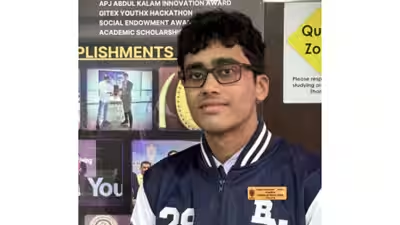
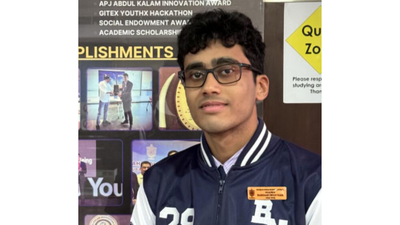
Most people who work in AI talk about the technology first. Bashaar Naik does the opposite. Ask the 19-year-old about any of his projects, and he will tell you about the problem before he tells you about the model, the dataset or the code behind it. It is a small distinction, but it explains almost everything about how he works.Naik was born in Mumbai in 2007 and has lived in the UAE since he was three months old, growing up in Sharjah and studying at Sharjah Indian School Juwaiza before joining the American University of Sharjah to study computer engineering. In that time, the country has shaped not just what he builds, but how he thinks about building it.
A country built on saying yes to ideas
Naik credits much of his outlook to the environment he grew up in, one that rewarded curiosity rather than caution.“UAE has taught me that true innovation is not simply about creating something impressive or technical. It is about addressing genuine challenges and making people’s lives better,” he told Gulf News.Access mattered too. Schools, universities, hackathons and exhibitions gave him a direct line to industry experts and mentors while he was still a teenager, something he does not take for granted. “The UAE gave me a safe, peaceful and opportunity-rich environment where young people are encouraged to experiment, take initiative and turn their ideas into reality.”
Three problems, three prizes
Naik’s project history reads less like a resume and more like a list of things that bothered him enough to fix.It started with soil. In 2022, he built an AI system that predicts soil mineral concentrations using data on composition, temperature, pH level and rainfall, aimed at helping farmers decide what to plant. The project won first prize at the GITEX YouthX Hackathon.A year later, his focus shifted to the roads. His 2023 project used AI to estimate vehicle fuel consumption, built to support fuel efficiency across the UAE. It took first prize at the Roads and Transport Authority (RTA) Dubai Sustainability and Transport Innovation Hackathon. “It gave me the chance to explore how AI can contribute to the UAE’s sustainability goals,” he said, according to Gulf News.By early this year, the problem had moved online. Naik and his team built a browser extension that detects deepfakes, designed to fight misinformation and digital fraud, for the InnovateX Hackathon run by the Telecommunications and Digital Government Regulatory Authority (TDRA). It won the Most Innovative Project award. “My aim is not simply to build technology, but to use it responsibly to solve genuine problems and make a meaningful difference in people’s lives,” Naik explained to Gulf News.Three different domains, three different technical problems, one consistent instinct: find what is broken, then decide if artificial intelligence (AI) is actually the right tool to fix it.
Recognition beyond the hackathon circuit
Naik’s work has travelled outside competition halls too. In 2022, one of his AI projects was selected by the Sharjah Private Education Authority for display at GESS Dubai, an exhibition for classroom technology. In 2023, the Indian Association Sharjah gave him its Social Endowment Award for his combined record in academics, innovation and community work.In 2024, he and his school team represented the Middle East in the international OTIS Made to Move Communities programme, placing second worldwide with EcoWheels, a sustainable transport concept. That same year, he topped his school’s Central Board of Secondary Education (CBSE) Grade 12 batch.He has also started building platforms for other young people, organising TEDxSISJ Youth, which brought together more than 30 student speakers, and later taking the stage himself to speak on the “Phygital World,” the blending of physical and digital life. “UAE has taught me not only to benefit from opportunities, but also to create them for others,” he said.
The part that has nothing to do with AI
Naik is careful to separate the tool from the philosophy. Artificial intelligence, he says, will keep changing. What should not change is the instinct to act.“Create your own opportunities. Do not wait for someone else to open the door for you,” he advised, encouraging other young people to connect with others, learn from their experiences and turn ideas into action rather than waiting for the ideal moment. “Taking action, showing up consistently and working hard can take you further than you can imagine”, he said, according to Gulf News.Ask him what he will be building five years from now, and he cannot say for certain. It may not even involve AI. But the method, he suggests, will stay the same: find the real problem first, and let the technology follow.