


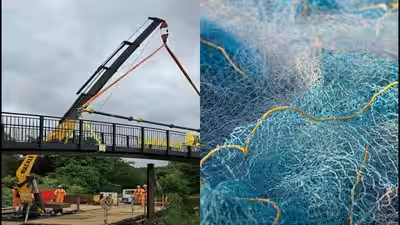
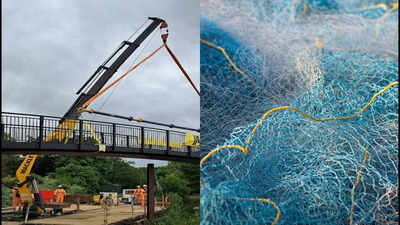
Old fishing nets seldom find a second life. But in Kent, England, the nets are being turned into something much more ambitious. The used nets have been transformed to make a 16-metre-long footbridge to carry people over a marina entrance with minimal environmental impact during construction. Media reports from 2024 say that the Environment Agency built an innovative bridge at Twyford Marina in Yalding using recycled materials, lightweight engineering, and a construction method to reduce the amount of concrete used. The 16-metre bridge is part of the Medway Valley Walk and offers pedestrians a new route across the entrance to Twyford Marina. It also makes it easier for boats to enter and leave the marina. The bridge deck and main structure are made of fibre-reinforced polymer, or FRP, from recycled old fishing nets. The material is a blend of strength and light weight and is particularly useful in a challenging construction location. According to reports, the completed bridge is much lighter at 3.5 tons than many traditional structures of a similar size. The weight reduction also allowed engineers to use smaller support foundations.
Lego-like construction system
The innovation is not only the bridge itself. If we go by the GOV UK website, the project used modular blocks, which mostly can be placed by hand, instead of traditional reinforced-concrete retaining walls. The blocks fit together like a Lego system, with little or no mortar needed. According to experts, this method requires less reinforced concrete, making construction simpler and potentially reducing the project’s carbon footprint. Lighter materials and smaller footings also allowed the bridge to be constructed in a site where it would have been difficult to deliver large construction equipment.
A journey by land and sea
The bridge’s journey to Kent was no less strange. According to the GOV UK website, the deck was built in the Netherlands before being shipped to Nottinghamshire and fitted with handrails. From there, the 3.5-ton structure was transported by road to Yalding. Her last voyage was by barge up the River Medway. When the bridge reached the marina, a crane set it in place. The bridge is now open to the public.
Lower carbon footprint, less maintenance
According to the 2024 report, the Environment Agency anticipates that the recycled FRP structure will require less maintenance than a conventional bridge built from traditional materials. It’s also lighter, which means the foundations it needs are smaller. Less construction material is required, and fewer emissions are generated. In the current scenario, the project shows how infrastructure is a place where pragmatic engineering and the circular economy meet. The project has given a new lease of life to discarded fishing nets, giving them a useful second life in a structure designed to serve walkers and boat users for years. On an ordinary journey, you now pass through an extraordinary piece of environmental engineering at Twyford Marina, made from waste that once belonged to the sea.Images Courtesy: GOV UK and istock