

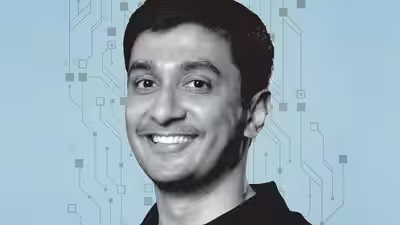

Artificial intelligence is usually associated with coding, chatbots and high-powered computing. Utkarsh Saxena is applying it to something much less glamorous but potentially far more consequential for India: the machinery of justice.Saxena, co-founder and CEO of Adalat AI, has been named among TIME’s 100 Most Influential People in AI for 2026. His journey is particularly unusual because he has seen India’s legal system from the inside. Before building Adalat AI, he worked as a law clerk at the Supreme Court of India.From the Supreme Court to AISaxena’s experience with the judiciary helped him understand a problem that technology could potentially address: the enormous amount of administrative and documentation work involved in court proceedings.Adalat AI develops AI tools for courtroom transcription and case-flow management. Its systems are designed around India’s linguistic and legal environment rather than simply adapting a generic speech-recognition product.The company’s current figures say its technology has reached more than 6,000 judges across 11 states.Why Indian courtrooms are a difficult AI problemCourt proceedings are not simply conversations that can be transcribed by a standard voice assistant.They can involve different Indian languages, accents, legal terminology and highly specialised courtroom vocabulary. In some courts, judges and staff also face significant administrative workloads.Adalat AI’s approach is to use AI to reduce some of that burden while keeping judicial decision-making firmly with judges.Saxena has emphasised that AI is meant to support the judiciary rather than replace it.Andhra Pradesh takes the technology statewideThe technology’s expansion has also moved beyond individual pilots.In July 2026, the Andhra Pradesh High Court announced that Adalat AI would be adopted across the state’s district judiciary from October 1. The company’s announcement said the mandate covers 733 district courtrooms and includes live transcription, case-flow management and other courtroom workflows.The scale makes the project an unusual example of AI being deployed directly inside public institutions.A different kind of AI careerSaxena’s educational and professional background also illustrates why understanding a problem can be as important as knowing how to build the technology.Adalat AI says he holds a BA/LLB from the University of Delhi, an LLM from Harvard Law School and a master’s in international development economics from Harvard Kennedy School. He is also pursuing a PhD in public policy at Oxford.For students, that combination is revealing. The future of AI will need computer scientists, but it will also require people who understand law, policy, healthcare, education and government.Why TIME recognised himSaxena’s inclusion in TIME100 AI 2026 reflects a broader understanding of AI influence.The biggest impact of artificial intelligence may not always come from the next giant language model. It could come from specialised systems quietly helping courts, hospitals, schools and governments work differently.From working as a clerk inside India’s Supreme Court to helping introduce AI across thousands of courtrooms, Saxena’s journey demonstrates what happens when technology is built around a real institutional problem.Disclaimer: This article is based on publicly available information and statements from the individuals and organisations cited. TOI Education has not independently verified all claims, figures or technical performance mentioned in the article.