


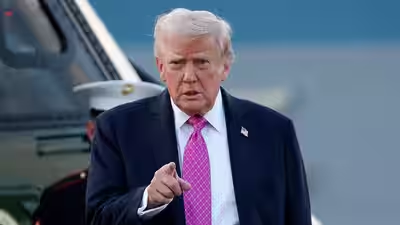
TOI Correspondent From Washington: The US Congress on Wednesday handed President Trump a surgical instrument to punish, at his discretion, not only Moscow but also countries that buy Russian energy, with India and China squarely in the crosshairs.The House of Representatives passed the “Sanctioning Russia and Iran Act of 2026” by a 262-159 margin, voted through by an unusually bipartisan coalition given the deep divisions in Washington: 203 Republicans, 58 Democrats and one Independent voted yes, while 152 Democrats and seven Republicans voted no. The Senate had already approved the measure 86-11 on August 7, meaning the legislation now goes directly to Trump’s desk for his signature.Named for the late Republican Senator Lindsey Graham, who died in July after championing the legislation for more than a year, the measure is designed primarily to squeeze Moscow’s revenues from its energy trade and increase pressure on President Putin to negotiate an end to the Ukraine war. It targets Russian energy and defence sectors, financial institutions, officials and the so-called “shadow fleet” of tankers accused of evading sanctions. It also extends the Iran Sanctions Act for five years.But its most consequential provision for India is the authority to impose tariffs of up to 100% on countries buying Russian oil or gas. The Senate language refers to the five largest purchasers; House debate and amendments have specifically brought India and China into focus. A House amendment identified ten countries potentially eligible for the secondary tariffs: China, India, Turkiye, Azerbaijan, Hungary, Slovakia, the UAE, Singapore, Kazakhstan and Kyrgyzstan.New Delhi is one of the world’s largest importers of Russian crude, which became increasingly important after Western sanctions redirected Russian oil toward Asian buyers. India says its priority is affordable and reliable energy for 1.4 billion people. China, meanwhile, has rejected the premise of the US imposing sanctions beyond its own borders, saying the move lacks a basis in international law or authorization from the UN Security Council.Economically, the stakes are substantial for India since any disruption to Russian crude supplies could significantly increase the country’s import bill and put pressure on the rupee and current-account balance. The MEA said on Thursday that India would take “all necessary measures to protect its trade and economic interests,” warning that the bill could affect bilateral ties and international energy markets.Indeed, even some prominent US analysts blasted the move, taking into account the large US-India ties, with former administration official Evan Feigenbaum saying it amounts to “blunt coercion, gross interference in Indian foreign policy, impractical given India’s economic needs… and a cynical effort to blame India for the West’s (and Trump’s) collective failure to get Moscow to stop its war on Ukraine.”“In strategic terms, if you value US.-India relations, this is not going to be a winning message. Broadly speaking, the last year-and-a-half has tanked 25 years of bipartisan work to build the US.-India relationship, including in Trump’s own first term,” Feigenbaum said.Critics also point to familiar American double-standards in the matter. The US itself continues to import Russian commodities, including nuclear fuel. Moscow has historically supplied 20–25% of US. enriched uranium, while Congress’s 2024 prohibition on Russian low-enriched uranium contains national-interest and supply-shortage waivers. The US also continues to buy Russian palladium, fertilizers and chemicals.The hypocrisy is compounded by the bill’s extraordinary delegation of tariff power, with some House Democrats arguing that Trump already possesses extensive sanctions authority. “We cannot grant more tariff power that we know he will abuse,” New York Congressman Gregory Meeks said, warning that the legislation could raise prices for Americans while giving the President excessive discretion.Supporters see precisely that discretion as leverage. Atlantic Council sanctions expert Daniel Fried, a former State Department sanctions coordinator, says the bill could allow Washington to negotiate gradual reductions in Russian oil purchases rather than demand an immediate cutoff, making presidential waivers a surgical instrument. The administration explicitly backed the legislation partly because it gives Trump “full Presidential discretion on waivers” and allows sanctions to be terminated after a peace agreement. The law therefore creates a threat rather than an automatic 100% tariff on India or China.For New Delhi, the practical battle now shifts from Capitol Hill to the Oval Office — and potentially to the rather interminable US.-India trade negotiations. Trump can sign the bill, designate countries, adjust tariffs as countries reduce Russian-energy purchases and use waivers as bargaining leverage. The question for India is therefore not simply whether Washington has fired the tariff gun, but how often and when Trump, fully armed, chooses to pull the trigger.