


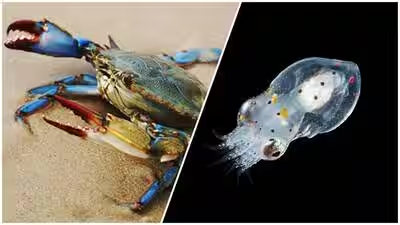
Italy is turning to an unusual predator in its battle against an invasive species that has wreaked havoc on the country’s fisheries: the common octopus.According to Scientific American, scientists have released around 130,000 young octopuses into the Adriatic Sea as part of an effort to control the growing population of invasive blue crabs, which have damaged shellfish stocks, fishing equipment and coastal fisheries.The initiative, known as Octo-Blu, is being led by researchers at the University of Bologna in collaboration with the Emilia-Romagna regional government.
Tiny octopuses released into Adriatic waters
The octopuses currently being released are not fully grown animals but newly hatched “paralarvae”, measuring only a few millimetres. They have been released into coastal waters, where they are expected to mature.The project began in 2024, initially focusing on laboratory work to determine how the young octopuses could be raised successfully in tanks.This summer, researchers released many of the young octopuses into open water near Cesenatico and Riccione, two areas among those particularly affected by the invasive blue crab population.The team has also placed artificial dens on the seabed to provide shelter for the vulnerable young octopuses as they grow.
One adult octopus can eat four blue crabs a day
The strategy relies on the common octopus’ natural appetite for crustaceans. Under suitable conditions, a one-kilogram adult octopus can consume around four medium-sized blue crabs in a single day.Antonio Casalini, an aquaculture research technician at the University of Bologna, said the project is not introducing an unfamiliar predator into the ecosystem.“We are not introducing a new species but working on strengthening the population of a native species already naturally present in the Adriatic,” Casalini said.That distinction is important because the common octopus is already native to Mediterranean waters, unlike the blue crab, which was introduced to the region.
Invasive blue crabs have devastated Italian fisheries
Blue crabs are considered a valuable seafood species in the Mid-Atlantic region of the United States. In the Mediterranean, however, their growing population has become a major ecological and economic problem.The species arrived in the Mediterranean last century, but its numbers began increasing rapidly about a decade ago.The consequences have been severe for Italian coastal communities, with blue crabs damaging fishing nets and feeding on clam beds and mussel stocks. Hundreds of fisheries along the Italian coast have reportedly been forced to close.The damage to the shellfish industry has cost tens of millions of euros, while the Italian government has invested heavily in attempts to contain and combat the invasive species.
Will the ‘octopus army’ work?
Despite the ambitious plan, scientists involved in the project acknowledge that releasing thousands of young octopuses does not guarantee that they will survive long enough to become effective predators.According to the reporting, mortality among octopus paralarvae can approach 99.9%, meaning only a very small proportion of those released could eventually reach adulthood.Gianluca Sarà, a marine ecologist at the University of Palermo who is not involved in Octo-Blu, described the concept as “powerful” and “great”, but cautioned that its impact in the real world could ultimately prove “absolutely negligible”.Researchers therefore do not expect the octopuses to eliminate blue crabs from the Adriatic.Casalini said the objective is instead to keep the invasive population under control, with the octopus project forming part of a broader strategy that also includes more aggressive fishing of blue crabs.The experiment represents an unusual attempt to use a native predator to restore some balance to an ecosystem disrupted by an invasive species. Whether Italy’s eight-armed solution can make a measurable difference, however, remains to be seen.