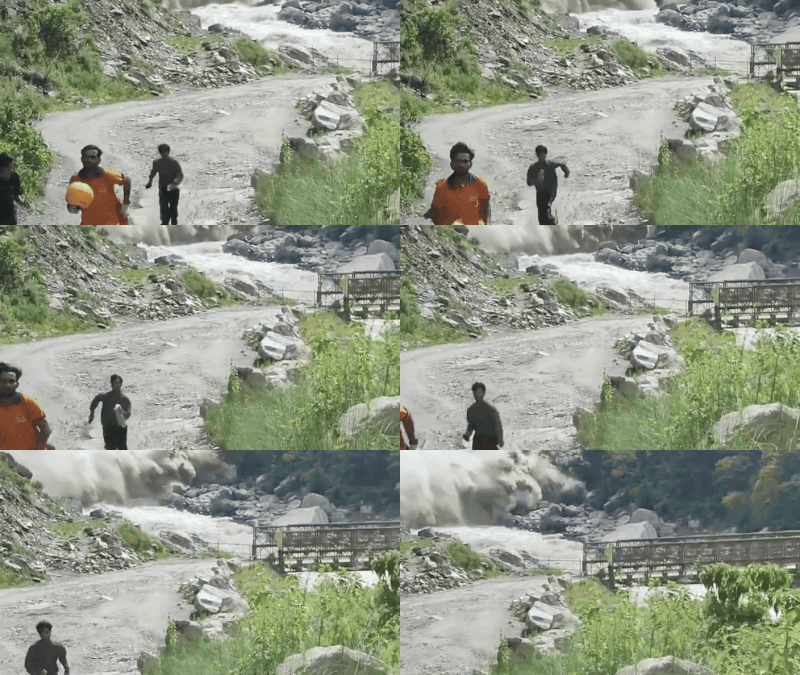


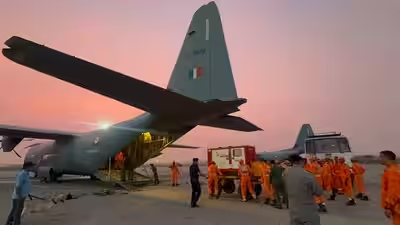
India’s armed forces have, once again, stepped up beyond the country’s own borders, and this is far from the first time. From responding to natural disasters to evacuating civilians caught in active war zones, the Army, Navy and Air Force have repeatedly rushed to the aid of citizens of other nations in distress, missions that have consistently showcased India’s ability to mobilise and respond at short notice, often within hours of a crisis breaking out. This time too, just hours after the flash flood struck Nepal, the Indian Air Force, dispatched a C-130 transport aircraft with 10 tonnes of relief and medical material. The air force has stated that it would be sending more relief materials in the coming days through the larger C-17 as well.India sees itself as the first responder to any natural or man made calamity in the broader region centered around the Indian Ocean Region (IOR). India had first demonstrated its capability in this role during the 2004 Boxing Day tsunami that ravaged Indonesia as well as other parts of South East Asia. The ability to deploy men and material across the region in compressed timelines also demonstrates India’s ability, if need be, to project power across the region to respond to any contingency. The air force and the army’s Parachute Brigade had executed Operation Cactus, in which, responding to a developing coup in the Maldives, a force was sent to the island nation that effectively dismantled the coup event.
During natural calamities too, the Indian armed forces have been quick to react and deploy assets to aid in the rescue and relief effort. The most recent instance came earlier this year with Operation Amistad in Venezuela, where two C-17 Globemaster aircraft carrying a full field hospital, 35 tonnes of relief supplies and a 41-member rescue team were dispatched to assist victims of a devastating earthquake, half the world away. Just months before that, in 2025, India launched Operation Sagar Bandhu for Sri Lanka after Cyclone Ditwah battered the island nation, helping restore critical communication links, evacuating over 2,500 people and delivering more than 1,000 tonnes of relief material. In the same year, following a powerful earthquake in Myanmar, the army set up a 60-bed field hospital under Operation Brahma. The navy and air force worked in tandem and ferried relief supplies to the affected region.2023 saw India mount three separate operations. Operation Dost saw Indian military aircraft and NDRF personnel rush to Turkey and Syria after a catastrophic earthquake flattened entire towns, delivering search-and-rescue teams and medical aid. The same year, Operation Kaveri evacuated thousands of Indian nationals from Sudan as fighting broke out between rival military factions in Khartoum, while Operation Karuna saw the armed forces deliver relief material to Myanmar in the aftermath of Cyclone Mocha.The year 2022 brought one of India’s largest and most complex evacuation efforts in recent memory, Operation Ganga, which saw the Air Force and civilian carriers work around the clock to bring back over 20,000 Indian students and citizens stranded in Ukraine as Russia’s invasion unfolded. A year earlier, as the Taliban swept back into power in Kabul, the Air Force carried out Operation Devi Shakti, airlifting Indian diplomats, officials and citizens out of Afghanistan under extremely tight security conditions.The Navy, too, has repeatedly proven its reach well beyond India’s own coastline. In 2020, Operation Vanilla saw Indian naval ships rush relief material to Madagascar after a cyclone struck the island nation, even as the country grappled with the early stages of the COVID-19 pandemic. That same year, Operation Samudra Setu became one of the Navy’s largest repatriation missions, bringing home thousands of stranded Indians by sea from Gulf countries and beyond. In 2017, Operation Insaniyat saw India send humanitarian aid to Bangladesh as it grappled with a massive influx of Rohingya refugees fleeing Myanmar.Earlier still, in 2016, Operation Sankat Mochan saw the Air Force airlift 156 Indian citizens to safety from Juba as fighting broke out in South Sudan. A year before that, in 2015, India carried out two of its most ambitious HADR missions yet, Operation Raahat, which evacuated over 4,700 Indians and nearly 2,000 foreign nationals from war-torn Yemen, and Operation Maitri, when India became the first country to respond to Nepal’s devastating earthquake, rescuing thousands and setting up field hospitals within days. Even earlier, in 2014, Operation Neer saw the Navy rush emergency drinking water supplies to Male after a fire crippled the Maldivian capital’s only water treatment plant.